Views: 82 Author: Site Editor Publish Time: 2025-09-03 Origin: Site
2. Overview of Handheld Laser Welding Technology
3. Reasonable Welding Process Design
4. Technical Application and Operational Standards
5. Economic Benefits and Market Prospects
In the rapidly evolving landscape of modern manufacturing, handheld laser welding technology is rapidly emerging as a pivotal tool for industry transformation and innovation. This technology combines the efficiency of laser welding with the advantage of portability, offering operators greater flexibility and precision to perform high-quality welding operations in diverse and complex environments. Suitable for diverse metal materials, it accommodates welding requirements across different thicknesses and joint configurations, finding extensive application in critical sectors such as automotive, electronics, and aerospace.
Within today's competitive landscape, enterprises face multifaceted challenges including cost control, production efficiency, and product quality. Enhancing production efficiency has become a core objective for sustainable manufacturing development. Handheld laser welding technology, with its high speed, precision, and minimal heat-affected zone, effectively shortens production cycles and reduces rework rates. This provides robust support for lowering production costs and boosting product competitiveness. By adopting this advanced technology, enterprises can gain a competitive edge in the global market, achieving higher production efficiency and economic benefits.
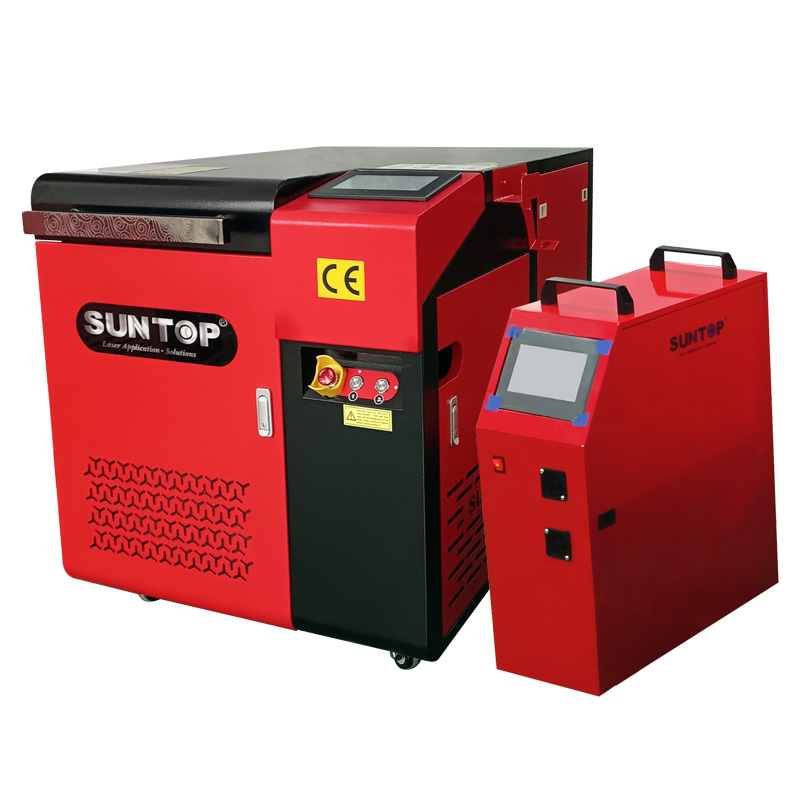
Handheld laser welding machines are advanced devices that utilize high-energy laser beams to weld materials. Their fundamental principle involves locally heating the welded material to a molten state through laser-generated heat, thereby forming a robust welded joint. The laser beam, after being focused by an optical system, can be precisely positioned at the welding site. This excites the molecular structure of the material, creating a molten pool and achieving fusion.
This technology's flexible operation enables seamless welding across diverse material surfaces and complex environments. The handheld design allows operators to weld within confined or irregular spaces without additional fixtures, significantly enhancing efficiency and convenience.
1. High Efficiency
Handheld laser welding achieves extremely rapid welding speeds, substantially reducing production cycles and meeting mass production demands.
2. Precision
Laser welding achieves exceptional positioning accuracy, enabling precise control over minute weld areas to ensure weld quality while minimizing defects and rework.
3. Flexibility
The handheld design allows laser welding machines to operate flexibly in diverse complex environments, adapting to varied work scenarios such as confined spaces or irregularly shaped workpieces.
4. Minimal Heat-Affected Zone
Laser welding produces a small heat-affected zone, minimizing material deformation and stress. This results in higher-quality welded joints while preserving the material's overall properties.
5. Environmental Friendliness
Handheld laser welding technology eliminates the need for welding rods or filler materials, reducing waste and harmful gas emissions. It complies with modern environmental standards.
6. Operational Simplicity
Featuring an intuitive interface, it is easy to learn and master, even for non-professionals, thereby reducing training costs.
Through these advantages, handheld laser welding technology is increasingly becoming a vital tool in modern manufacturing for enhancing production efficiency and product quality, driving innovation and development within the industry.
Prior to welding, material pre-treatment is a critical step to ensure weld quality. First, impurities on the material surface—such as oil, rust, and oxide layers—must be removed, as these contaminants affect laser beam absorption and the bond strength of the welded joint. Unclean surfaces may lead to uneven welds and reduced reliability, thereby increasing the risk of rework.
Additionally, optimizing joint design is vital. Proper joint geometry and gap settings enhance melt pool stability, ensuring weld quality. For instance, selecting appropriate joint angles and widths considering material thermal expansion and contraction characteristics effectively minimizes deformation and stress concentration during welding. Completing these preparations establishes a solid foundation for subsequent welding operations.

Each parameter in the welding process significantly impacts final weld quality. Adjusting laser power, welding speed, and heat input according to material type and thickness is key to optimizing results.
● Laser Power: For thicker materials, increase laser power to overcome heat dissipation and ensure sufficient temperature for proper molten pool formation. For thin materials, lower power settings are preferable to prevent excessive melting and deformation.
● Welding Speed: Welding speed directly affects melt pool size and weld quality. Excessively high speeds may result in insufficient melt pool formation and poor welds, while excessively low speeds can cause overheating and weld defects. Therefore, an appropriate welding speed should be selected based on the material's thermal properties and welding requirements.
● Heat Input: Controlling heat input is critical. Excessive heat input may cause welding distortion or enlarged heat-affected zones, while insufficient input may result in poor welds. Appropriate heat input ensures the strength and quality of the welded joint.
Through rational parameter optimization, production efficiency can be significantly enhanced while ensuring weld quality meets standards.
During welding, real-time monitoring systems are essential for quality assurance. By installing sensors and monitoring equipment, critical parameters such as laser power and welding speed can be tracked in real time. This monitoring not only identifies potential issues like welding defects or material overheating promptly but also triggers immediate alerts.
Based on monitoring feedback, operators can adjust parameters—such as fine-tuning laser power or welding speed—to adapt to changing material properties or environmental conditions, thereby maintaining process stability and high-quality results. The real-time feedback mechanism effectively reduces human error, enhances welding efficiency, and ensures optimal results for every weld.
By effectively integrating meticulous material preparation, parameter optimization, and real-time monitoring, enterprises can significantly boost the efficiency and quality of handheld laser welding technology in production processes, driving overall improvements in manufacturing standards.
Professional training for operators is critical in the application of handheld laser welding technology. First, the complexity of the welding process requires operators to not only understand basic welding principles but also master equipment operation procedures, parameter settings, and safety protocols. Through systematic training, operators can effectively identify material properties, select appropriate welding parameters, and prevent defects caused by improper operation.
Second, training enhances operators' ability to identify and address equipment malfunctions and welding issues, enabling timely resolution of technical challenges that may arise during production. Additionally, heightened safety awareness is a key training component, ensuring operators understand and adhere to protective measures to prevent laser radiation exposure and other potential safety hazards.
● Turkish Client
A Turkish client adopted handheld laser welding technology to boost production line efficiency. By implementing optimized welding processes and parameters, the company increased welding speed by 25% during production. Feedback indicates this technology significantly reduced welding defects, ensured weld strength and overall quality, and markedly enhanced market competitiveness.
● Spanish Customer
Our Spanish client utilizes handheld laser welding machine for metal joining. Through specialized operator training and technical support, the welding process achieved high flexibility and rapid adaptability to diverse products. Results demonstrated a 30% reduction in production cycle times, alongside decreased rework and returns due to improved weld quality.
● German Customer
Our German metal processing client applied handheld laser welding technology in their production, demonstrating exceptional performance particularly when welding large structural components. By implementing a real-time monitoring system, the factory can promptly adjust welding parameters to maintain high-quality welds. This has boosted production efficiency by 20% while reducing material waste and production costs, earning widespread praise from the client.
These real-world applications not only demonstrate the success of handheld laser welding technology in boosting production efficiency across diverse industries but also underscore the importance of professional training and rational process design. They provide valuable insights for other enterprises considering similar technological implementations.
The introduction of handheld laser welding technology delivers significant economic benefits by reducing production costs, minimizing material waste, and lowering rework rates.
● Reduced Production Costs: Handheld laser welding technology significantly boosts production line output through its high efficiency and rapid welding speed. Faster welding speeds translate to shorter production cycles, thereby lowering fixed costs per unit. Additionally, the equipment's low maintenance requirements and energy-saving performance further reduce operational expenses.
● Reduced Material Waste: Laser welding achieves high-precision joints with minimal heat-affected zones, enabling more efficient material utilization. Unlike traditional welding methods where excessive heat input often causes material deformation and loss, laser welding minimizes such issues, lowering material procurement and usage frequency.
● Reduced Rework Rates: High-quality welded joints decrease rework and inspection costs associated with welding defects. The precision of handheld laser welding ensures finished products meet higher quality standards, thereby reducing the incidence of rework and after-sales service, saving associated time and expenses.
By adopting handheld laser welding technology, enterprises can not only enhance production efficiency but also contribute to lowering overall operational costs, yielding significant economic benefits.
Market demand for handheld laser welding technology is steadily increasing, primarily driven by the following factors:
● Manufacturing Transformation and Upgrading: As global manufacturing shifts toward automation and intelligent processes, enterprises increasingly require efficient welding solutions. Handheld laser welders, valued for their flexibility and adaptability, are becoming a key choice for enhancing production efficiency.
● High Precision and Multi-Functional Applications: Market demand for high-precision welding and multi-material processing capabilities continues to rise. Handheld laser welding enables efficient joining across diverse materials, meeting the highly customized and precision welding requirements of numerous industries (such as automotive, aerospace, electronics, etc.), further driving its widespread adoption.
● Environmental Sustainability: As societal demands for environmental protection and sustainable development intensify, the low energy consumption and reduced waste characteristics of handheld laser welding align with modern industrial trends, comply with environmental regulations, and gain favor.
● Projected Growth Potential: Market research indicates the handheld laser welding market will maintain rapid growth in the coming years, with strong investment intent across multiple industries for its applications. This trend attracts increasing numbers of enterprises to enter the field, driving technological innovation and market competition.
Market demand for handheld laser welding technology continues to grow, demonstrating robust development prospects. This not only provides greater commercial opportunities for enterprises implementing the technology but also propels the enhancement of overall manufacturing competitiveness.

Against the backdrop of rapid advancements in modern manufacturing, the strategic adoption of handheld laser welding technology has become pivotal for enhancing production efficiency and market competitiveness. Through precise, efficient, and flexible welding processes, this technology not only optimizes production workflows but also effectively reduces costs, minimizes material waste, and lowers rework rates, thereby delivering substantial economic benefits.
We urge manufacturing enterprises to actively explore and adopt this technology to address intensifying market competition and evolving customer demands. By implementing handheld laser welding, companies can achieve substantial progress in innovation and sustainable development, laying a solid foundation for future production models.
In summary, embracing handheld laser welding technology is not only an effective pathway to enhance corporate efficiency and profitability but also a crucial step in driving industry innovation and sustainable development. Let us work together to fully unlock the potential of this technology, guiding manufacturing toward a smarter, greener future.
Table of Contents1. Introduction
Table of Contents1. Introduction2. Overview of UV Laser Marking Machines3. Marking Effects on Different Materials3.1 Non-metallic Materials3.2 Metal Materials4. Advantages of UV Laser Marking5. Application Examples of UV Laser Marking6. Conclusion
Table of Contents1. Introduction