Views: 145 Author: Site Editor Publish Time: 2026-08-13 Origin: Site
4. Suitable for Industry Applications
5. Results of the Solution Implementation
Currently, the tube processing industry still widely relies on traditional methods such as sawing and mechanical punching, resulting in significant overall production bottlenecks. Traditional processes are slow, and tube cutting often leads to issues such as burrs, uneven cut edges, and large dimensional deviations, making it difficult to ensure a high product yield rate. At the same time, production heavily relies on manual material cutting, positioning, and secondary finishing, which requires a large labor input, leads to low production efficiency, and makes it difficult to meet the delivery demands of high-volume orders.
In complex pipe processing scenarios, operations such as cutting, punching, beveling, and slotting for round, square, rectangular, and various special-shaped pipes require multiple machines to complete the process in separate steps. The cumbersome procedures and complex production workflow significantly increase equipment investment and facility costs. The current tube market is trending toward small batches, diverse styles, and customization. Traditional fixed-configuration processing equipment lacks flexibility and cannot adapt to these flexible, diversified production demands.

As industrial environmental regulations continue to tighten and labor costs rise year after year, the drawbacks of traditional processing models—high labor costs, high material waste, and low efficiency—are becoming increasingly apparent. Given these industry trends, tube processing companies urgently need to upgrade their production equipment and adopt automated, intelligent laser tube cutting solutions to achieve a modern production transformation characterized by labor savings, increased efficiency, and reduced costs.
1. Production Line Positioning: A fully automated fiber laser tube cutting production line that emphasizes unmanned operation, integrated design, and a smart production model compatible with all types of tubes. It provides a one-stop solution to replace traditional multi-equipment, multi-process machining models, meeting the demands of modern, large-scale, and flexible tube production.
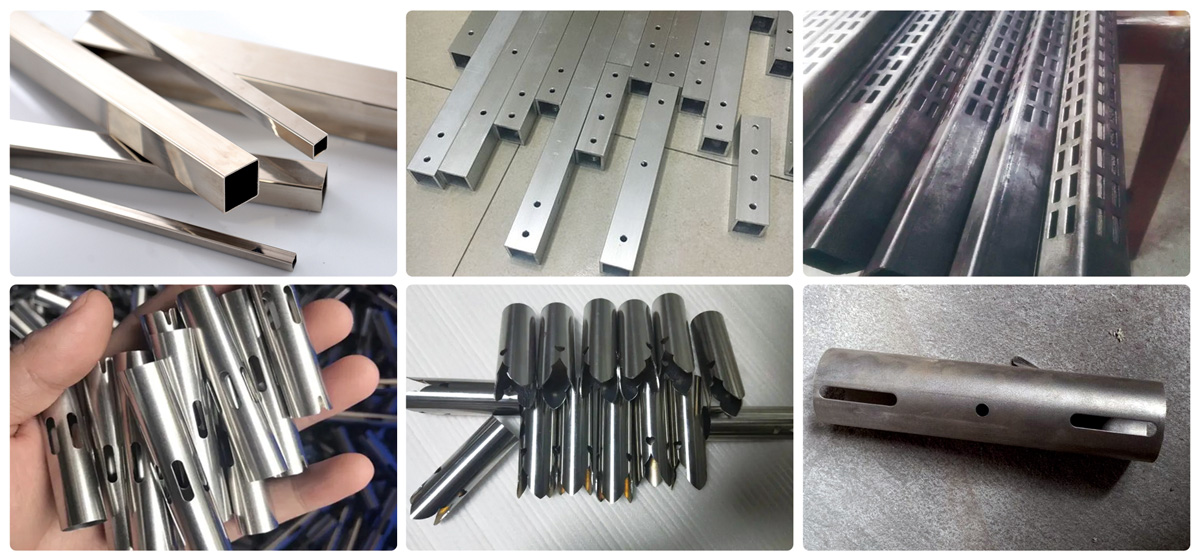
2. Supported Tube Types: The equipment offers exceptional compatibility, capable of comprehensively processing conventional tubes such as round, square, and rectangular tubes. It also supports the precise processing of channel steel, angle steel, and various types of special-shaped metal tubes, covering the vast majority of tube processing applications in the hardware, steel structure, and automotive parts industries.
3. Core Processing Technologies: Integrating multifunctional laser processing capabilities, the system can complete complex processes—including tube cutting, precision hole drilling, bevel cutting, bevel grinding, tube engraving, and irregular contour cutting—in a single operation. By consolidating multiple processes into a single integrated workflow, it eliminates the need for secondary processing and significantly streamlines the production process.
4. System Configuration: The complete intelligent production line consists of an automatic loading rack, a fiber laser tube cutting machine, an intelligent unloading mechanism, an automatic sorting system, and a dedicated dust collection system. With a high degree of integration and a comprehensive automation workflow, the system enables fully automated operations from raw material loading and processing to clean output.
1. Fully Automatic Loading and Unloading for Labor Savings and High Efficiency: The equipment supports automatic loading of entire bundles of tubing, intelligent edge detection, and automatic cut-to-length cutting. The entire process requires no manual intervention, significantly reducing reliance on labor and effectively alleviating labor shortages for businesses.
2. Integrated Processes for Cost Reduction and Efficiency Improvement: A single laser pipe cutting machine can fully replace multiple traditional processing machines—such as sawing machines, drilling machines, beveling machines, and grinding machines—by integrating multiple production steps. This streamlines production line configuration, reduces equipment investment, and minimizes floor space requirements.
3. High Processing Precision, Burr-Free Cuts: Utilizing a controlled laser precision machining process ensures accurate and stable cutting paths. Pipe cuts are flat, smooth, burr-free, and distortion-free, eliminating the need for manual secondary grinding or finishing and significantly improving the first-pass yield rate.
4. Suitable for Customized Production with Broad Versatility: Compatible with all types of complex machining drawings, it easily handles customized processing such as irregular-shaped pipe fittings, multi-angle cuts, and special contours, perfectly meeting the industry’s needs for small-batch, multi-product, and flexible production.
5. High material utilization and reduced waste: Equipped with an intelligent nesting and cutting system, it automatically optimizes tube cutting paths to make efficient use of raw materials. Compared to traditional processing methods, it saves 10%–15% in material usage, effectively reducing raw material procurement costs.
6. High Equipment Stability, Suitable for Mass Production: The machine offers stable performance and a low failure rate, enabling 24-hour uninterrupted continuous operation. It fully meets the mass production demands of industries such as guardrails, warehouse racking, automotive parts, and construction machinery.

1. Steel Guardrail Industry: Suitable for standardized, batch cutting of various protective guardrails, construction fencing, and steel structural tubing, ensuring uniform dimensions and high-quality cuts, and meeting the processing needs of high-volume mass production orders.
2. Warehouse, Home, and Hardware Industry: Capable of precise cutting and forming for warehouse shelving, construction trusses, and metal furniture tubing. With stable processes, it is suitable for the large-scale production of standard profiles.
3. Construction Machinery and Automotive Parts Industry: Provides customized cutting, drilling, and chamfering for automotive frames, agricultural machinery, and construction machinery with irregularly shaped tubing. With high precision, it is suitable for the production of high-end components.

4. Precision Hardware Manufacturing Industry: Supports the finishing of precision tubing for fitness equipment, bathroom hardware, and metal lighting fixtures. Finished products are burr-free and require no secondary processing, offering superior appearance and assembly precision.
5. Construction Engineering Industry: Specializes in the cutting and processing of various special-shaped and complex-profile tubes used in building curtain walls and steel structure projects. Capable of achieving complex processes through integrated forming to meet customized construction standards.
1. Streamlined Labor Input: Leveraging a fully automated production process, the solution significantly reduces the need for manual labor in tasks such as loading/unloading, positioning, and polishing. This enables a single operator to oversee mass production across multiple machines, effectively alleviating labor shortages and reducing labor costs.
2. Doubled Production Efficiency: Compared to traditional pipe processing methods, overall processing efficiency increases by 2–3 times. This enables rapid adaptation to high-volume order production, significantly shortens order delivery cycles, and enhances the company’s ability to accept and fulfill customer orders.
3. Stable and Controllable Product Quality: The equipment utilizes intelligent CNC precision machining to ensure uniform pipe cutting dimensions and excellent cut quality, greatly improving product consistency and effectively reducing defect rates and the likelihood of rework.
4. Saves Factory Floor Space: By integrating multiple processes—including cutting, drilling, beveling, and grinding—a single machine replaces multiple traditional models, significantly reducing the space required for equipment, optimizing factory layout, and improving space utilization.
5. Reduced Overall Production Costs: With no need for grinding consumables, no frequent rework, and lower labor and management costs, coupled with higher material utilization, long-term production effectively reduces a company’s overall operating costs, including consumables, production, and management expenses.
A fully automated fiber laser tube cutting production solution, tailor-made for the intelligent upgrade of the tube processing industry, specifically addresses industry pain points such as low efficiency, high reliance on manual labor, poor processing accuracy, high overall costs, and cumbersome production processes. By leveraging automated loading and unloading, integrated processing, high-precision forming, and intelligent nesting and cutting, this solution comprehensively optimizes the tube production process, helping enterprises reduce labor costs, improve product quality, shorten delivery cycles, and minimize production waste. This solution is widely adaptable to the customized and mass production needs of tube processing across multiple industries. It empowers tube processing enterprises to achieve automated, intelligent, and intensive mass production upgrades, precisely aligning with future industry trends toward customization, high quality, and fast delivery. It provides robust equipment and technical support to help enterprises improve quality, increase efficiency, and achieve green production.
Table of Contents1. Introduction
Table of Contents1. Introduction2. Overview of UV Laser Marking Machines3. Marking Effects on Different Materials3.1 Non-metallic Materials3.2 Metal Materials4. Advantages of UV Laser Marking5. Application Examples of UV Laser Marking6. Conclusion
Table of Contents1. Introduction