Views: 143 Author: Site Editor Publish Time: 2026-07-01 Origin: Site
2. Shortcomings of Traditional Wood Processing
3. Core Advantages of CO2 Laser Equipment
4. Main Application Scenarios of CO2 Laser Wood Processing
5. Common Misconceptions & Optimization of CO2 Laser Wood Processing
In traditional wood processing, basic processes such as cutting, carving, engraving, and drilling rely heavily on traditional mechanical tools combined with manual labor. This overall processing model has significant shortcomings and pain points. Traditional equipment has limited processing precision, easily resulting in burrs, chipped edges, and scratches on the workpiece after cutting and carving, leading to rough finished products that require secondary sanding and finishing. This process is cumbersome, labor-intensive, and inefficient. Furthermore, limitations in molds, tools, and processes prevent traditional processing from achieving complex patterns, intricate cutouts, and micro-characters, resulting in limited pattern styles and weak customization capabilities. High reliance on manual operation leads to poor product consistency and a high scrap rate, causing material waste and failing to meet the current market's diversified, refined, and personalized demands for wood products.
With the continuous upgrading of the furniture, home furnishings, cultural and creative gifts, wooden packaging, and craft ornament industries, the wood processing industry is undergoing a new development transformation. High-precision processes, personalized customization, efficient mass production, non-contact and non-destructive processing, and standardized output have become the mainstream development trends in the industry. Consumers and buyers are increasingly demanding higher levels of detail, complexity, and uniformity in wood products, rendering traditional, extensive processing methods inadequate for modern production pace.
Against this industry backdrop, intelligent laser processing equipment is gradually replacing traditional techniques. CO2 laser cutting and engraving equipment, with its precise, non-contact processing, wide adaptability, and highly efficient and stable proprietary technology, perfectly addresses various pain points in traditional wood processing. It is widely used in wooden handicrafts, whole-house furniture, customized cultural and creative products, high-end wooden box packaging, and many other fields, and has become the mainstream and preferred equipment in the fine wood processing industry.
Traditional wood processing equipment, limited by its structure and processes, suffers from significant shortcomings in precision, flexibility, and mass production capacity, making it difficult to meet the demands of modern high-end wood processing.
Traditional mechanical cutting involves contact cutting, which physically compresses and rubs the wood during processing, easily causing problems such as chipping, fraying, scratches, and cracking, resulting in a high probability of workpiece breakage. Furthermore, limitations in tool shape and trajectory restrict it to simple cutting, grooving, and conventional carving, making it impossible to achieve intricate openwork, complex curves, and micro-textures, severely limiting processing options.
Hand carving heavily relies on the skill and experience of master craftsmen, resulting in inconsistent quality, poor uniformity in depth, lines, and details, and a high defect rate. Moreover, hand carving is cumbersome, slow, and has a long production cycle, making it suitable only for small-scale sample production and completely unsuitable for the pace of industrialized mass production.
While ordinary CNC woodworking equipment can achieve automated processing, its programming is cumbersome, debugging is time-consuming, and response time for product modifications and changes is slow. For small-batch, multi-style customized orders, the equipment debugging and time costs increase significantly, the cost-effectiveness of customization is low, the overall processing flexibility is extremely poor, and it is difficult to adapt to the ever-changing customization needs of the current market.
Compared to the numerous drawbacks of traditional woodworking equipment, CO2 laser cutting and engraving equipment, with its unique laser processing principle and mature industrial performance, perfectly meets the demands of modern precision wood processing. It possesses comprehensive competitive advantages in terms of technology, efficiency, cost, and versatility, which is the core reason why it has become the mainstream equipment in the wood processing industry.
1. Non-contact Processing, Complete Protection of the Original Wood Texture
CO2 laser processing adopts a non-contact operation mode. The processing process does not require the tool to contact the workpiece, and it does not generate any mechanical pressure, friction, or impact on the wood surface. This eliminates common processing defects such as board deformation, chipping, cracking, and surface scratches at the source, preserving the original texture and feel of the wood to the greatest extent. Whether it is thin wood chips, fragile bamboo, or soft wood materials, it can achieve non-destructive processing, effectively reducing the probability of workpiece breakage and scrap, and is suitable for the production of various high-quality, high-requirement wood products.
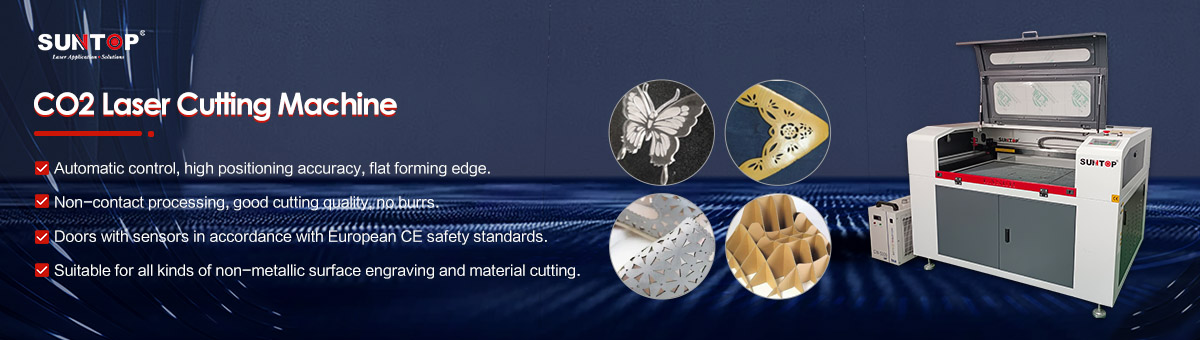
2. Ultra-high Processing Precision, Extremely Strong Detail Expression
The equipment's laser spot is finely focused, and the energy distribution is uniform, enabling micron-level precision processing, breaking through the technological limitations of traditional equipment. This equipment can easily complete high-precision processes such as fine patterns, miniature characters, 3D gradient carving, complex hollow shapes, and irregular curve cutting, producing clear lines, distinct layers, and natural transitions. It can reproduce the effects of various complex design drawings, solving the problem of fine modeling that traditional processes cannot achieve, significantly enhancing the refinement and added value of wood products.
3. Strong Material Compatibility, Adaptable to Most Wood Materials
This equipment boasts extremely high processing versatility and is highly adaptable to various common wood materials. It can stably process solid wood, paulownia, pine, bamboo, MDF, plywood, multi-layer board, wood cardboard, wood veneer, acrylic wood, and other materials. Regardless of softwood or hardwood, or board thickness, matching processing parameters can be adjusted, resulting in uniform and stable processing effects. One machine can meet the production and processing needs of multiple materials and categories of wood products, making it suitable for a wide range of scenarios.
4. Flexible and Efficient Processing, Balancing Customization and Mass Production
CO2 laser equipment boasts a high degree of intelligence, with fully computerized digital control. Design drawings can be imported with a single click for rapid processing, eliminating the need for mold making, tool changes, and complex debugging. Product modifications, drawing changes, and parameter adjustments are simple and quick, with a fast response time, making it highly suitable for small-batch, multi-style personalized customization orders. Simultaneously, the equipment supports continuous high-speed operation for extended periods, with a stable and efficient processing cycle, fully meeting the large-scale, standardized mass production needs of large industrial plants, perfectly balancing both customized production and large-scale mass production scenarios.
5. Superior Finished Product, Significantly Simplified Post-Production Processes
Laser-processed wood cuts have smooth, burr-free, serrated, and burnt edges, with clean and clear engraved lines. No need for tedious manual secondary sanding, trimming, or polishing processes. This greatly simplifies the production process, reduces post-production labor input, effectively saves labor costs, reduces material waste, and significantly improves overall enterprise production efficiency while increasing product yield.
6. Simple and Convenient Operation, Lowering the Labor Threshold for the Industry
The equipment is equipped with user-friendly intelligent operating software, with built-in comprehensive wood processing preset parameters. The interface is simple and easy to understand, and the functions are intuitive. No professional programming knowledge is required, nor does it rely on the craftsmanship experience of senior carpenters. Ordinary operators can quickly learn to operate the equipment and independently complete sampling and production after simple training. This effectively solves the industry pain points of scarcity of experienced technicians, high labor costs, and difficulty in hiring skilled workers, helping companies reduce labor costs and production management pressure.

With its excellent processing precision, flexible customization capabilities, and stable mass production results, CO2 laser wood processing equipment has widely penetrated multiple industries, adapting to various scenarios such as personalized customization and industrial mass production. It is currently the core equipment for the fine processing of wood products, with mainstream applications covering cultural and creative gifts, furniture and home furnishings, wooden packaging, and craft ornaments.
1. Cultural and Creative Gifts Industry
In the field of customized cultural and creative gifts, the fine processing advantages of CO2 laser equipment are particularly prominent. It can perform personalized carving and precise cutting on various small wooden items. It is suitable for processing wooden ornaments, cultural and creative keychains, antique-style bookmarks, decorative photo frames, commemorative wooden plaques, etc., supporting customized text, patterns, logos, blessings, and other exclusive content. The processed textures are delicate and exquisite, with flexible and varied styles, meeting consumers' personalized and creative customization needs, significantly enhancing the aesthetics and collectible value of cultural and creative wooden products.

2. Furniture and Home Furnishings Industry
In furniture and home furnishing production, the equipment can achieve high-end fine woodworking processing, adapting to carving, hollowing, and logo engraving processes on various solid wood boards and furniture panels. Commonly used in furniture 3D carving, panel hollowing, wood grain embellishment, home decoration carving, and cabinet labeling. The processed lines are smooth and neat, without chipping or burrs, and can adapt to various home styles such as light luxury, antique, and minimalism, helping to upgrade and iterate home products and create a high-end, exquisite woodwork feel.
3. Wooden Packaging Industry
Targeting the high-end packaging market, CO2 laser cutting and engraving can complete the fine processing of various wooden packaging products. It is widely used in the cutting and engraving processes of high-end wooden gift boxes, solid wood wine boxes, tea boxes, product trays, and inner wooden bases. It can accurately engrave brand logos, product information, anti-counterfeiting patterns, decorative patterns, etc., with clear, three-dimensional, and high-quality results. It can effectively enhance the product packaging grade and brand image, making it a core processing equipment for high-end wooden packaging customization and mass production.

4. Arts and Crafts Industry
This equipment is suitable for the artistic processing of various bamboo and wood craft products, covering niche craft products such as bamboo handicrafts, wooden Christmas ornaments, holiday decorative wooden pieces, wooden figurine accessories, artistic carved ornaments, and wooden puzzles. It can achieve effects that are difficult to achieve with traditional techniques, such as complex artistic carvings, irregularly shaped hollow cuts, and fine texture carving. The finished products are exquisite and delicate, with a high yield rate, meeting the stringent requirements of the arts and crafts industry for detail, aesthetics, and craftsmanship precision. It is suitable for both small-batch customization and large-scale mass production
In the actual production process of CO2 laser wood processing, many companies have fixed misconceptions in process debugging and equipment use, leading to quality problems such as blackening and scorching of finished products, incomplete cutting, rough edges, and uneven depth of cut. This not only affects the aesthetics of the product but also increases the scrap rate and production costs. Mastering the correct process debugging methods and daily usage specifications can effectively stabilize processing quality and improve the finished product qualification rate.
1. Common Processing Misconception: Using Universal Parameters to Process All Woods
Many operators, in an effort to simplify the setup process, habitually use the same set of laser parameters to process different types and thicknesses of wood. This is the most common misconception in wood laser processing. Different types of wood vary greatly in density, hardness, and moisture content. Softwoods such as pine and paulownia are porous and easily blacken at high temperatures; MDF and hardwoods are dense and harder, and conventional parameters can easily result in incomplete cuts and inconsistent carving depths. Processing with uniform parameters directly leads to various defects in the workpiece, such as scorched edges, yellowing or blackening of the surface, incomplete cuts at the bottom, and blurred grain, severely affecting the quality of the finished product and causing material waste.
2. Process Optimization Solution: Material-Specific Parameter Adjustment and Supporting Auxiliary Processes
For different types of wood, laser power, processing speed, and focus distance need to be adjusted specifically based on the wood's hardness, thickness, and material characteristics. For thin, soft wood, laser power can be appropriately reduced and processing speed increased to prevent high-temperature buildup that could cause the board to scorch and turn yellow. For high-density, thick wood, power needs to be moderately increased and processing speed reduced, combined with precise focusing, to ensure thorough cutting and uniform carving depth. Simultaneously, an air blowing system must be kept running throughout the processing to promptly remove high-temperature fumes and wood chips, effectively preventing scorched edges and blackening, resulting in a smoother cut surface, more uniform carving color, and significantly improved product quality.
3. Daily Use and Maintenance Recommendations: Standardized Operation and Stable Equipment Performance
Daily equipment maintenance is crucial for ensuring long-term processing accuracy and product stability. During production, laser lenses, galvanometers, and worktables must be cleaned regularly to promptly remove attached sawdust, dust, and oil stains, preventing lens contamination that could lead to laser energy attenuation and processing misalignment or blurring. Operators must adhere to standardized parameter setting procedures. New materials and new orders must be sampled and tested first to confirm the effect before mass production, preventing batch defects caused by blind mass production. Simultaneously, maintaining a well-ventilated and dry working environment with stable voltage, and regularly checking the water cooling and transmission systems, can effectively extend equipment lifespan, reduce equipment failure rates, and ensure consistently stable laser processing results, guaranteeing consistent quality in long-term mass production.
Compared to traditional wood processing techniques, CO2 laser cutting and engraving equipment offers comprehensive advantages in processing precision, production efficiency, process flexibility, and product quality, effectively solving industry pain points such as numerous burrs, low precision, slow modification, and high scrap rates. With its non-contact precision processing, mold-free operation, adaptability to multiple materials, and ability to handle both customization and mass production, the equipment perfectly aligns with the modern wood processing industry's trends of personalized customization, standardized production, and intelligent upgrading. As the woodworking industry continues to iterate and upgrade, CO2 laser equipment will be more widely adopted, helping processing companies streamline processes, reduce production costs, stabilize product quality, effectively enhance market differentiation competitiveness, and assist the industry in achieving efficient, high-quality, and green intelligent production transformation.
Table of Contents1. Introduction
Table of Contents1. Introduction2. Overview of UV Laser Marking Machines3. Marking Effects on Different Materials3.1 Non-metallic Materials3.2 Metal Materials4. Advantages of UV Laser Marking5. Application Examples of UV Laser Marking6. Conclusion
Table of Contents1. Introduction