Views: 141 Author: Site Editor Publish Time: 2026-10-21 Origin: Site
2. Comparison of Sheet Metal Welding Processes: Traditional Welding vs. Handheld Laser Welding
3. Key Advantages of Laser Welding Machines for Sheet Metal
4. Typical Applications for Sheet Metal
5. Highlights of the 4-in-1 Multifunctional System
6. Selection Guide: Choosing the Right Power for Sheet Metal Processing
As the demand for custom sheet metal fabrication grows, there is an increasing need for higher precision and superior aesthetic quality in products such as enclosures, equipment housings, and stainless steel decorative components. Traditional welding methods—such as argon arc welding (TIG) and gas metal arc welding (MIG/MAG)—present significant drawbacks when applied to thin-gauge sheet metal. High heat input often causes the material to warp or deform, while the resulting weld seams are frequently rough and prone to oxidation or blackening. This necessitates extensive manual grinding and polishing, which extends production cycles. Furthermore, thin-sheet welding using these conventional techniques is highly susceptible to defects like burn-through and porosity, leading to higher scrap rates. Additionally, these traditional methods demand a high level of operator expertise; the scarcity of skilled welders, combined with rising labor costs, has become a major obstacle for sheet metal enterprises looking to scale up production.
The market urgently requires a new welding solution that balances weld quality and production efficiency while lowering the skill threshold for operators. In this context, handheld laser welding has emerged as a highly effective solution. Its advantages—including low heat input, aesthetically pleasing weld seams, and ease of operation—provide a viable path for sheet metal fabricators to upgrade their manufacturing processes. This article explores how handheld laser welding addresses the pain points of traditional methods and enhances the quality of metal sheet welding in fabrication environments.
1. Heat Input and Thermal Distortion
Traditional methods—such as TIG (argon arc) welding and MIG/MAG (gas-shielded arc) welding—involve high heat input, which spreads extensively across the material. This often causes sheet metal to warp or twist, necessitating post-welding straightening and leveling. In contrast, handheld laser welding delivers highly concentrated energy, resulting in a minimal heat-affected zone (HAZ) and a lower overall temperature rise in the workpiece. This significantly reduces thermal distortion, making it particularly well-suited for precision thin-sheet metal components.
2. Weld Bead Formation and Post-Welding Finishing
Traditional welding produces wide, heavily oxidized, and rough, blackened weld beads, requiring extensive grinding and polishing—a labor-intensive process. Laser welding, however, creates narrow, smooth, and clean weld beads with minimal oxidation. This allows for a substantial reduction in grinding requirements; in many cases, workpieces can proceed directly to the next stage of production without any need for grinding.
3. Stability in Processing Thin Sheets (Common Thickness Range: 0.8–6 mm)
Processing thin sheets (0.8–3 mm) is a significant challenge in sheet metal fabrication. Traditional welding methods are highly prone to burn-through and the formation of porosity. Handheld laser welding offers precise energy control, ensuring high stability when welding thin sheets and effectively preventing burn-through. For medium-thickness sheets (4–6 mm), both processes are viable, though laser welding consistently results in less distortion.
4. Operational Complexity and Labor Costs
Traditional welding requires a high level of technical expertise, extensive hands-on training, and reliance on skilled, experienced welders—all of which drive up labor costs. Handheld laser welding systems feature built-in, preset parameters, making them simple to operate. Workers can become proficient with only short-term training, reducing a company’s dependence on highly skilled welders and lowering labor costs.
5. Summary: Processing Efficiency and Yield Rates
Traditional welding is more time-consuming per unit and carries a higher scrap rate; the additional time required for post-welding straightening and grinding further extends the overall production cycle. Handheld laser welding offers faster welding speeds, fewer defects, and higher yields. It requires minimal post-weld processing, resulting in significantly better overall production efficiency compared to traditional welding methods—making it well-suited for batch sheet metal production.
1. Aesthetic and Smooth Welds, Significantly Reducing Post-Processing Grinding
Handheld laser welding features concentrated energy and high precision, resulting in fine, uniform weld seams with dense weld spots and minimal oxidation—leaving a clean, bright surface. Unlike the rough, blackened beads produced by traditional welding, laser-welded parts require little to no secondary processing, such as extensive grinding, polishing, or rust removal. This drastically cuts down on post-processing time, lowers the consumption of materials and labor costs, and ensures a consistent, high-quality appearance across batch production—perfectly meeting the standards for visible sheet metal components.
2. Minimal Heat-Affected Zone: No Deformation or Burn-Through in Thin Sheets, Ensuring High Yield Rates
Sheet metal processing typically involves thin plates (0.8–6 mm), which are the most challenging materials for traditional welding methods. Laser welding delivers energy instantaneously and precisely, creating a very small heat-affected zone and keeping the overall temperature of the workpiece low. This effectively prevents issues like warping, deformation, or indentations in thin sheets. Furthermore, with adjustable parameters and stable, controllable energy, laser welding eliminates defects such as burn-through, porosity, and weak/incomplete welds, significantly boosting the yield rate of sheet metal components and reducing losses from rework or scrap.
3. Flexible Handheld Operation, Ideal for Complex Sheet Metal Structures (Irregular Shapes, Corners, and Joints)
Equipped with a lightweight handheld welding torch, the system offers high operational freedom, unconstrained by workpiece geometry or complex fixtures. It easily handles challenging areas—such as sheet metal joints, right-angle corners, curved surfaces, interior sections of enclosures, and complex bent parts—that are difficult to access with traditional equipment. This makes it highly suitable for a wide range of non-standard sheet metal products, including electrical enclosures, equipment housings, decorative sheet metal, and custom-shaped brackets, offering greater flexibility for on-site operations and a broader range of applications. 4. Simple and Intuitive Operation, Reducing Reliance on Highly Skilled Welders
Traditional argon arc welding and gas-shielded arc welding (MIG/MAG) demand a high level of technical expertise; skilled welders are scarce and command high labor costs. Handheld laser welding machines feature intelligent, pre-set process parameters and a clean, intuitive interface. This eliminates the need for specialized welding training, allowing general staff to operate the equipment independently after only a short period of instruction. This effectively addresses common industry challenges—such as difficulties in recruitment, high labor costs, and long learning curves for new hires—thereby lowering the threshold for personnel requirements and easing management pressure.
5. Broad Material Compatibility, Covering Most Common Sheet Metal Materials
This equipment offers exceptional versatility, capable of reliably welding a wide range of metals frequently used in sheet metal fabrication, including carbon steel, stainless steel, galvanized sheets, cold-rolled sheets, and aluminum alloys. Whether the application involves standard structural sheet metal, corrosion-resistant stainless steel, or lightweight aluminum components, the machine delivers high-quality, robust welds with consistent seam integrity. A single unit can handle diverse sheet metal processing requirements, offering superior versatility and a higher price-to-performance ratio.

1. Sheet Metal Welding for Enclosures and Cabinets
In the production of electrical enclosures, equipment cabinets, and network racks, high standards for surface flatness and structural stability are essential. Handheld laser welding enables precise joining of corners and seams; the resulting welds are smooth, refined, and free from significant deformation. This eliminates the need for extensive post-weld grinding or finishing, ensuring the overall squareness and high-quality appearance of the cabinets—meeting the requirements for standardized, batch production.
2. Assembly of Equipment Housings and Sheet Metal Cabinets
Metal housings and cabinets for industrial machinery, automation equipment, and instrumentation are often constructed by joining thin metal sheets. Traditional welding methods frequently cause deformation or unsightly blackening of the weld seams, compromising the equipment's overall aesthetics and quality. Handheld laser welding, with its minimal thermal distortion and superior finish, is ideal for joining large sheets and framework components. It produces flat, uniform housings that meet the rigorous structural and aesthetic standards required for high-end equipment.

3. Welding of Decorative Stainless Steel Sheet Metal
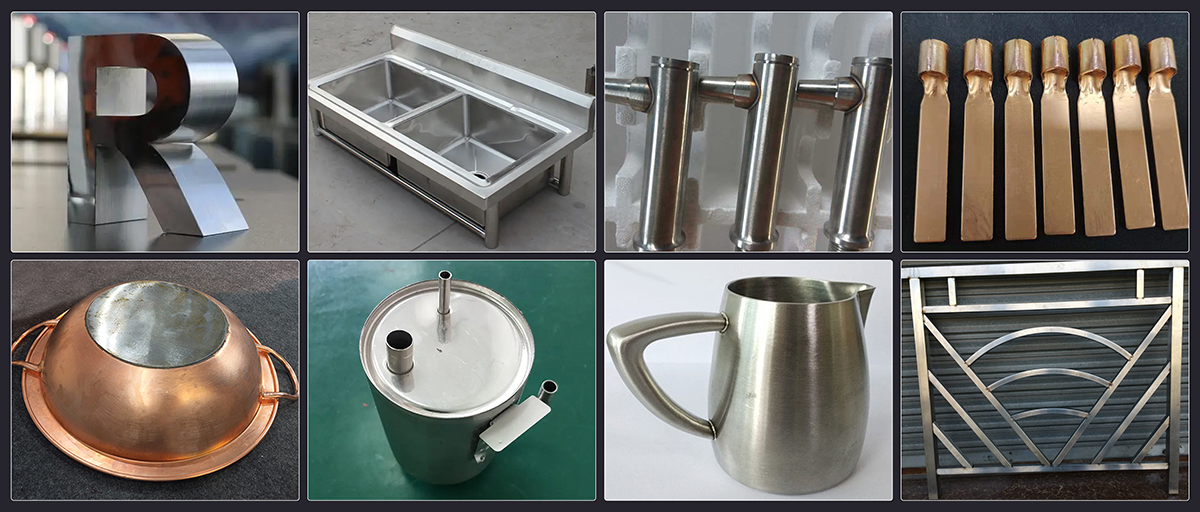
Decorative stainless steel components—used in interior/exterior fit-outs, kitchen and bathroom hardware, municipal installations, and storefront elements—demand a flawless appearance, with no visible weld marks, deformation, or color discrepancies. Laser welding creates fine, low-oxidation seams, leaving a clean surface that preserves the original texture of the stainless steel. This removes the need for laborious polishing, ensuring high-precision, visually appealing finished products.
4. Welding of Thin-Sheet Guards and Brackets for Construction Machinery
Components for construction machinery—such as thin-gauge protective guards, mounting brackets, and shielding—are often thin and subjected to complex operating conditions, yet they must maintain high structural integrity. Handheld laser welding offers high speed, robust weld joints, and a minimal heat-affected zone. It effectively prevents deformation and cracking in thin-sheet components, balancing structural strength with surface flatness—making it well-suited for the routine, high-volume welding of construction machinery parts.
5. Welding of Complex-Shaped Bent Parts and Irregular Sheet Metal Seams
In the processing of non-standard, custom-made sheet metal components, one frequently encounters complex-shaped bent parts, curved structures, and irregular seams. Traditional stationary welding equipment often struggles to perform precise welds, while manual welding is both difficult and prone to defects. A handheld laser welding torch, by contrast, is flexible and lightweight; it can access weld seams from various angles and directions. This allows it to easily handle complex geometries, narrow gaps, and irregular joints, making it an ideal solution for the diverse requirements of non-standard, custom sheet metal fabrication.
Designed to meet the diverse, cost-sensitive production requirements of sheet metal processing enterprises, our upgraded 4-in-1 handheld laser system breaks through the functional limitations of traditional, single-purpose equipment. By integrating multiple core processing technologies, it provides a one-stop solution for tasks such as sheet metal welding, post-weld treatment, and cutting. Compared to conventional single-function machines, this system offers superior utility and cost-effectiveness, empowering sheet metal manufacturers to boost efficiency.
This system seamlessly integrates four key functions—welding, laser cleaning, weld seam finishing, and sheet metal cutting—covering the essential processes of sheet metal fabrication. It enables precise welding of various metal sheets and components, while also featuring professional-grade laser cleaning and weld polishing capabilities. Furthermore, it handles the precise cutting of thin sheets and profiles. This eliminates the cumbersome, multi-machine workflows typical of traditional production, making it ideal for both custom, non-standard sheet metal fabrication and high-volume production.
Addressing the most labor-intensive stage of sheet metal production—post-weld grinding—this system allows for immediate laser cleaning of weld seams. Once welding is complete, there is no need to transport the workpiece or switch equipment; a simple one-touch operation shifts the system into cleaning mode. It rapidly removes oxidation layers, weld spatter, and discoloration, while refining the surface of the weld. This replaces traditional manual grinding, polishing, or sandblasting, significantly reducing labor requirements and avoiding common issues such as uneven grinding, material wear, and dust pollution—all while enhancing the visual quality of the finished sheet metal products.
The core advantage of this multifunctional integration is its ability to replace multiple traditional machines. Enterprises no longer need to purchase separate laser welders, cleaning machines, cutters, and polishing tools, leading to substantial savings on equipment procurement, maintenance, and spare parts. Moreover, the system features a compact, lightweight design that minimizes its factory footprint, making it an excellent choice for small-to-medium-sized sheet metal processing plants and custom fabrication workshops. It helps businesses streamline their equipment setup, optimize production workflows, and improve overall operational efficiency.
Matching the power output of a handheld laser welder to the specific thickness and material of a sheet metal workpiece maximizes welding efficiency and ensures stability, while preventing energy waste caused by excessive power. The following guide provides practical power-selection recommendations for the sheet metal industry, covering the vast majority of standard processing applications.
1. 1500W Model: Precision Welding for Thin Sheets
The 1500W laser welder is designed primarily for thin-sheet processing. It is suitable for various metal sheets with a thickness of 0.8–3mm, making it an ideal choice for items such as enclosures, cabinets, stainless steel housings, and decorative sheet metal components. With a moderate and controllable heat output, it effectively prevents burn-through and deformation in thin materials. It offers high welding precision and an excellent surface finish, making it a highly cost-effective solution for the precision welding and mass production of thin-walled sheet metal products.
2. 2000W Model: The Versatile All-Rounder
The 2000W model is the industry standard for general sheet metal processing. It handles sheets ranging from 1mm to 4mm in thickness—covering both thin and medium-gauge materials—and is compatible with most carbon steel and stainless steel workpieces. It is equally effective for welding thin-walled decorative parts and equipment enclosures, while also meeting the structural strength requirements for standard sheet metal components. Offering an optimal balance of welding speed, finish quality, and versatility, it is well-suited for sheet metal fabrication facilities that handle a diverse range of products.
3. 3000W/6000W Models: Specialized for Medium-to-Thick Plates and Aluminum Alloys
These high-power models (3000W and 6000W) are engineered specifically for processing medium-to-thick sheet metal. They are ideal for materials exceeding 4mm in thickness and for structural, load-bearing sheet metal components, providing deep weld penetration, robust seams, and high operational stability. It is also perfectly suited for challenging materials—such as aluminum alloy sheets and thick galvanized plates—effectively resolving issues like cold (weak) welds, shallow penetration, and incomplete fusion. It is ideal for high-strength welding applications, including sheet metal components for construction machinery, enclosures for heavy-duty equipment, and aluminum alloy structural parts.
As the sheet metal processing industry shifts toward greater precision and efficiency, the drawbacks of traditional welding methods—such as significant thermal deformation, low yield rates, high labor costs, and cumbersome post-processing—have become increasingly apparent, making them ill-suited for today’s diverse production requirements. Handheld laser welding machines offer key advantages, including minimal thermal deformation, high-quality weld seams, ease of operation, and exceptional versatility. They effectively address critical industry pain points—such as the risk of burn-through or deformation when welding thin sheets, the labor-intensive nature of grinding weld seams, and the difficulty of recruiting skilled welders. By enhancing weld quality and production efficiency while significantly reducing overall operational and maintenance costs, these machines provide an excellent, high-efficiency solution for the technological evolution of the sheet metal industry.
The SUNTOP four-in-one multifunctional laser welding system integrates welding, weld seam cleaning, laser cleaning, and sheet cutting. This versatile, cost-effective, and highly adaptable equipment is perfectly suited to the needs of small-to-medium-sized sheet metal workshops and enterprises specializing in custom, non-standard metal fabrication. These businesses often handle a wide variety of product types and material thicknesses, requiring high production flexibility. With this system, they can complete the entire processing workflow without the need for multiple specialized machines—saving both factory floor space and capital investment. It enables these enterprises to handle everything from batch production to bespoke, custom orders with ease, helping them reduce costs, boost efficiency, enhance product competitiveness, and achieve a smarter, more streamlined production model.
Table of Contents1. Introduction
Table of Contents1. Introduction2. Overview of UV Laser Marking Machines3. Marking Effects on Different Materials3.1 Non-metallic Materials3.2 Metal Materials4. Advantages of UV Laser Marking5. Application Examples of UV Laser Marking6. Conclusion
Table of Contents1. Introduction