Views: 163 Author: Site Editor Publish Time: 2026-03-26 Origin: Site
2. Overview of Laser Rust Removal Technology
3. Challenges of Cleaning Complex Shapes
4. Laser Rust Removal Solutions
5. Practical Application Cases
Metal surface cleaning plays a crucial role in industrial production and maintenance, particularly for metal components with complex structures and shapes. Removing rust, oxides, and other contaminants during the cleaning process not only enhances the metal’s appearance but also significantly improves its corrosion resistance and service life. For metal components with complex shapes—such as mechanical parts, molds, and welded joints—ensuring that every detail is effectively cleaned is even more critical, as these areas are often key to performance and safety.
Name1
Name2
Name3
Name4
Traditional cleaning methods, such as manual grinding, chemical cleaning, and sandblasting, while effective in certain situations, face numerous limitations when dealing with complex metal structures. These methods often struggle to reach hard-to-access areas, potentially resulting in incomplete cleaning and thereby reducing the quality of the metal surface and its corrosion resistance. Additionally, traditional methods may cause physical damage to the metal surface or introduce new contaminants.
In contrast, the advantages of laser rust removal technology are evident. By precisely focusing a high-energy laser beam on the corroded areas, it achieves contactless cleaning, minimizing physical impact on the substrate. Laser rust removal is characterized by high efficiency, environmental friendliness, and broad applicability, making it perfectly suited to address the challenges of cleaning complex metal surfaces. This makes laser technology an ideal choice for modern metal surface treatment, enhancing work efficiency while ensuring precise and long-lasting cleaning results.
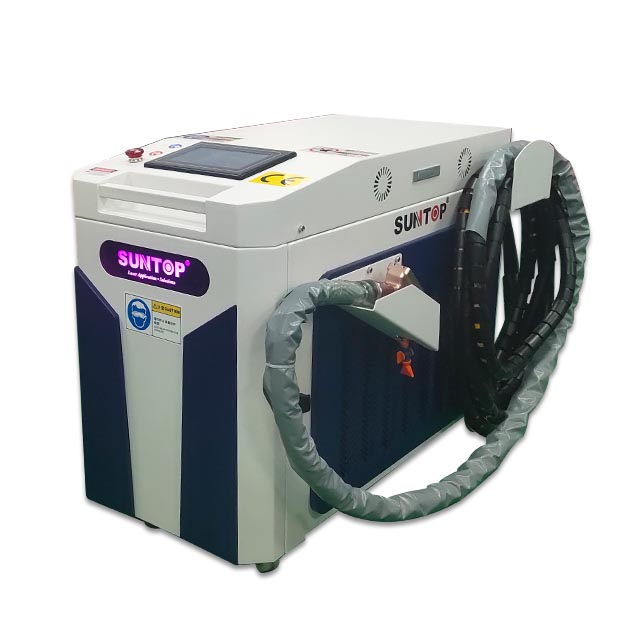
Laser rust removal technology is a highly efficient method for cleaning metal surfaces. It uses a high-energy laser beam to precisely remove rust, oxides, and other contaminants from metal surfaces. The basic principle involves focusing the laser’s energy; when the laser beam strikes the metal surface, the energy is rapidly absorbed by the rust or contaminants, causing these substances to instantly evaporate or vaporize, thereby achieving a clean surface. This non-contact cleaning method is not only environmentally friendly but also effectively protects the base material.
● High Precision: Laser rust removal technology allows for precise control of the laser beam’s focal length and power, enabling targeted cleaning of specific rusted areas. Since the cleaning is concentrated on specific regions, it does not cause unnecessary damage to surrounding materials, making it particularly suitable for metal components with complex shapes and high-detail requirements.
● High Efficiency: Laser rust removal can rapidly remove surface rust and contaminants, with a cleaning speed far exceeding that of traditional methods. The laser’s high energy output allows for the processing of large work surfaces within an hour, significantly improving work efficiency while reducing processing time and labor costs.
● Low Heat Affected Zone: Laser rust removal technology is characterized by a minimal heat-affected zone. Due to the focused laser beam and instantaneous heating, temperature fluctuations in the treatment area are minimal, avoiding issues such as metal deformation, melting, or surface hardening that may occur with traditional cleaning methods. This characteristic makes laser rust removal particularly effective when processing heat-sensitive materials.
These advantages have led to laser rust removal technology gaining increasing prominence in industrial manufacturing. It is widely applied in the automotive, aerospace, and manufacturing sectors, providing an efficient, precise, and safe solution for metal surface treatment. Through laser rust removal, companies can enhance production efficiency, reduce maintenance costs, and minimize environmental impact, thereby meeting the sustainability requirements of modern industry. Click here for more information
When dealing with metal components of complex shapes, traditional cleaning methods face numerous challenges. These issues not only affect cleaning effectiveness but can also negatively impact the quality and performance of the final product.
● Hard-to-reach Areas: Complex metal structures often feature narrow crevices, intricate corners, and curved surfaces. Traditional cleaning methods—such as manual grinding, chemical cleaning, or sandblasting—struggle to effectively reach these inaccessible areas. Rust or contaminants may remain in these hidden spots, resulting in incomplete cleaning that compromises the metal’s durability and appearance.
● Potential Surface Damage: When using traditional cleaning methods, particularly during mechanical grinding and sandblasting, operators often need to apply significant pressure to ensure rust is removed. This can result in scratches, deformation, or excessive wear on the metal surface. Such surface damage not only affects the aesthetic appeal of the metal component but may also compromise its structural integrity, increasing the difficulty and cost of subsequent maintenance.
● Subsequent Issues Caused by Incomplete Cleaning: When cleaning complex components, traditional methods cannot guarantee that every seam and surface layer is thoroughly cleaned. Unremoved rust or oxides may cause adhesion failures, reduced corrosion resistance, and other issues during subsequent processes (such as coating, welding, or assembly), leading to more serious quality risks. Additionally, incomplete cleaning may accelerate the corrosion rate of the metal, shortening its service life.
Therefore, given the limitations of traditional methods for cleaning complex metal surfaces, the industry urgently needs to shift toward more efficient and safer solutions, such as laser rust removal technology, to ensure thorough cleaning results and the integrity of the metal surface. Click here for more information
When performing laser rust removal, it is crucial to select the appropriate laser power and type. The choice of laser power typically depends on the following factors:
● Material Type: Different materials (such as steel, stainless steel, aluminum, etc.) have varying laser absorption rates. For example, metallic materials generally require higher-power lasers to effectively remove rust.
● Degree of Rust: The more severe the rust, the higher the laser power typically required. For metal surfaces with minor rust, a lower power (such as 1000–1500 W) may be sufficient, whereas severely rusted components may require laser equipment with 2000 W or higher.
To enhance cleaning effectiveness, the use of specialized laser nozzles and fixtures is essential.
● Laser Nozzles: Custom laser nozzles can improve the focus and spray pattern of the laser beam, enhancing cleaning efficiency and precision. By adjusting the nozzle design, the laser can better adapt to components with complex shapes, ensuring every detail is effectively cleaned.
● Fixtures: Using custom fixtures stabilizes metal components, ensuring they remain in the correct position during the cleaning process. This not only improves the safety of laser rust removal but also prevents incomplete cleaning caused by workpiece movement.
When performing laser rust removal, the following operational techniques will help you achieve optimal results:
● Adjusting Beam Focus and Speed Settings: Adjust the laser beam’s focus and operating speed appropriately based on the material and degree of rust. A smaller focal spot improves cleaning precision, while a moderate speed effectively removes surface rust without damaging the base material.
● Segmented Operation Strategy: For complex surfaces, a segmented operation method is recommended. Divide the entire cleaning process into multiple small areas, cleaning each area separately to ensure thoroughness and precision. This allows for flexible adjustment of laser settings based on the specific shape of the surface.
● Combining Localized Cleaning with Global Scanning: When cleaning complex metal surfaces, combine localized precision cleaning with comprehensive scanning to ensure coating adhesion and surface quality. First, use a high-precision laser to clean key areas, followed by a global scan to ensure the entire workpiece meets the expected cleaning standards. This method not only improves efficiency but also ensures uniform cleaning results.
With these laser rust removal solutions, you can efficiently and precisely clean complex metal surfaces, enhancing processing quality and extending the service life of the material. Click here for more information
Due to prolonged exposure to harsh environments, automotive chassis components suffer from severe rust, which compromises both safety and appearance.
Laser rust removal technology is employed, utilizing a fiber laser machine to thoroughly clean the chassis. By adjusting the laser power and focal length, the cleaning process targets the areas with the most severe rust while preventing damage to other parts of the chassis.
After cleaning, the chassis surface regained its metallic luster, with all rust and grime effectively removed. This provided excellent adhesion conditions for subsequent painting and protective coatings, significantly improving the vehicle’s overall safety.
Production equipment in manufacturing plants had accumulated significant rust and grime due to long-term use, affecting operational efficiency.
Laser rust removal technology was introduced, using a laser scanning head to clean every part of the equipment. A segmented approach was adopted to clean each component individually, ensuring comprehensive and meticulous coverage.
Upon completion, the equipment’s operational performance improved significantly, reducing downtime, extending the equipment’s service life, and substantially lowering subsequent maintenance costs.
A ship maintenance company needed to address rust issues on an aging hull, requiring the complete removal of surface rust without compromising the hull’s structural integrity.
A laser rust removal system was employed to clean the hull surface layer by layer. Technicians adjusted the laser’s focal length and power to accommodate the hull’s complex curves, ensuring uniform cleaning results.
After laser cleaning, the hull regained an ideal foundation for corrosion protection, ready for repainting. This enhanced the vessel’s durability and appearance while extending its operational lifespan.
In large-scale construction projects, steel structures accumulate rust and contaminants on their surfaces after years of use, compromising both overall aesthetics and safety.
Laser rust removal technology is used to thoroughly clean steel structures, with particular attention given to hidden corners and hard-to-reach areas.
After laser cleaning, the steel structure surfaces are restored to like-new condition, providing an excellent foundation for subsequent coating and ensuring both the building’s aesthetic appeal and structural safety.
Molds develop rust and accumulate grime due to repeated use, which affects production efficiency and the quality of finished products.
Laser rust removal technology is employed to precisely clean every part of the mold, with laser parameters adjusted to accommodate the mold’s varying materials and shapes.
After laser rust removal, the mold surface becomes shiny and spotless, enhancing the mold’s durability, significantly improving the quality of subsequent products, and extending the mold’s service life.
The above cases demonstrate the successful application of laser rust removal technology in industries such as automotive manufacturing and repair, industrial equipment, shipbuilding and repair, construction and infrastructure, and molds. With its high efficiency, precision, and environmental friendliness, laser rust removal technology provides an ideal metal surface cleaning solution for various industries, further enhancing product quality and production efficiency. Click here for more information
1. How does laser rust removal technology work?
Laser rust removal technology uses a high-energy laser beam to irradiate the metal surface. The laser energy is absorbed by rust and contaminants, causing them to heat up rapidly and evaporate or vaporize, thereby cleaning the metal surface. This method is non-contact, minimizing physical impact on the base material.
2. What types of metal materials is laser rust removal suitable for?
Laser rust removal technology is suitable for a wide range of metal materials, including steel, stainless steel, aluminum, copper, and their alloys. It can also be used to treat metal components with complex shapes and intricate details.
3. Why choose laser rust removal over traditional cleaning methods?
Laser rust removal offers advantages such as high precision, high efficiency, and a minimal heat-affected zone. Compared to traditional methods, lasers can remove rust and contaminants more thoroughly, particularly in hard-to-reach areas, without damaging the base material.
4. How long do the results of laser rust removal last?
The cleaning results of laser rust removal typically last for an extended period, depending on the post-cleaning surface treatment (such as anti-corrosion coatings) and the operating environment. Applying a high-quality protective coating can significantly extend the rust-preventive effect.
5. Does the laser rust removal process have an impact on the surrounding environment?
Laser rust removal is a clean process that produces no hazardous waste or polluting gases and causes no physical damage, making it environmentally friendly. During operation, it is recommended to implement necessary safety measures to ensure the safety of operators.
6. How does the cleaning speed of laser rust removal compare to traditional cleaning methods?
Laser rust removal is generally faster than traditional cleaning methods and can process larger metal surfaces in a shorter time. The specific speed varies depending on the material, degree of rust, and equipment parameters.
7. Can laser rust removal be used outdoors?
Yes, but it is necessary to ensure that environmental conditions are suitable and to take appropriate protective measures.
8. How effective is laser rust removal for cleaning complex metal surfaces?
Laser rust removal technology is particularly well-suited for cleaning complex metal surfaces. Its high precision and flexibility allow it to handle surfaces of various shapes, ensuring that every detail is effectively cleaned—achieving results that traditional methods cannot.
Laser rust removal technology has proven to be both essential and highly efficient for cleaning complex metal surfaces. By leveraging the precise focusing and high energy of high-power lasers, laser rust removal effectively removes rust and contaminants from metal surfaces, making the cleaning process not only efficient but also minimizing damage to the base material. Its unique advantages make it particularly well-suited for complex curved surfaces and geometries that are difficult to address with traditional cleaning methods.
In today’s rapidly evolving industrial landscape, the quality of metal surfaces directly impacts product performance and service life. The adoption of laser rust removal technology not only significantly enhances cleaning results but also provides an excellent foundation for subsequent surface treatments and coatings, thereby extending the service life of metal components, reducing maintenance costs, and improving overall production efficiency.
Therefore, we encourage enterprises and users across all industries to actively adopt laser rust removal as an advanced cleaning technology to meet future challenges and enhance the quality and reliability of metal surfaces. In the pursuit of higher standards in production processes and a more sustainable development path, laser rust removal technology will become an indispensable tool. By leveraging technological innovation to advance metal surface treatment, we believe that the future of industry will become more efficient, environmentally friendly, and sustainable.

Table of Contents1. Introduction
Table of Contents1. Introduction2. Overview of UV Laser Marking Machines3. Marking Effects on Different Materials3.1 Non-metallic Materials3.2 Metal Materials4. Advantages of UV Laser Marking5. Application Examples of UV Laser Marking6. Conclusion
Table of Contents1. Introduction